“Gorillas in the Mist” In
the realm of the Mountain Gorilla, Rwanda
Meet Mountain
Gorilla Project Veterinarian Dr. Mike Cranfield and/or the Regional Field Veterinarians
10 days and 9 nights -
leave on a Friday, back on a Sunday
A unique adventure indeed. We will visit Rwanda,
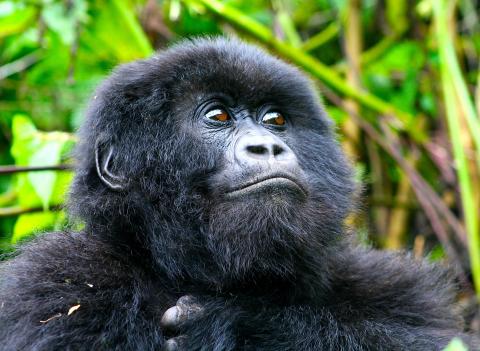
home to the critically endangered Mountain Gorilla, where we shall TWICE
track these gentle giants. The Mountain Gorillas inhabit some of the most
spectacular scenery on earth, high on the flanks of the Virunga Volcanoes.
We will also take the opportunity to visit the grave of famed primatologist
Dian Fossey, who dedicated her life to the conservation and protection
of these animals. A veterinarian from the Mountain Gorilla Veterinary
Project will join us during this ecotour, and will detail some of the
threats facing these incredible animals.
Group size is limited to 16 individuals.
Departure dates in May, June and October 2008; May, July and December 2009 Cost per person is $5,649 ($6,649 in 2009)
Single supplement is $1,000
For each participant a donation will be made to the Mountain
Gorilla Veterinary Project to continue the important task of providing
preventive and emergency health care to these critically endangered creatures. See detailed itinerary below.
Spend one full week in Rwanda, see the Savannah wildlife of Akagera National Park, and then walk in the footsteps of Dian Fossey, and sit with one of our closest living relatives, the critically endangered Mountain Gorillas. Just one moment with these magnificent and gentle creatures will take your breath away, but on this Ecotour you will have the once-in-a-lifetime opportunity to take not one, but TWO treks to see the Mountain Gorillas! We will visit the unique mist-shrouded habitat of these animals atop the Virunga Volcanoes of Rwanda.
We will meet one of the Veterinarians working with the Mountain Gorilla Veterinary Project, and hear about the struggles involved in keeping the critically Endangered Mountain Gorilla population healthy and thriving.
This is an Ecotour that will make a difference to you, and to the areas we visit.
We will donate to the important work of the Mountain Gorilla Veterinary Project.
We will employ local people.
We will use locally owned and operated lodges and outfitters.
We will use local goods and services.
Day 1: Friday evening. Depart USA for Europe
Late afternoon flights leave home headed for Rwanda, via Brussels, Amsterdam or London. Meals aloft. (D)
Day 2: Saturday. Europe to Kigali, Rwanda
After our overnight flight we can enjoy some time at leisure in Amsterdam, London or Brussels. We then board our flight headed for Rwanda. (If you choose to arrive into Rwanda on Saturday you will be met upon arrival at the International Airport and transferred to the Kigali Serena Hotel - included - and can relax for the night). Meals aloft, or overnight in Kigali Serena Hotel. (B,D)
Day 3: Sunday. Akagera National Park, Rwanda
Today we are either met on arrival at the International Airport, or at the Kigali Serena Hotel, and depart for Akagera National Park in the east of Rwanda bordering Tanzania. This is just a two-hour drive and we should be at the Lodge in time for lunch. We can clean-up, settle into our rooms, relax poolside and late this afternoon we should have chance for a "Game Drive" before sunset. Welcome dinner and orientation at the Lodge this evening. Overnight at Akagera Lodge. (B,L,D)
Day 4: Monday. Akagera National Park
An early morning game drive in the Park should reward us the chance to see a variety of birds, elephant, hippo, giraffe, spotted hyena, buffalo and crocodiles. We return to the Lodge in time for lunch, and then we shall plan on a short siesta. Later this afternoon we may enjoy a canoe ride on Lake Ihema, which is very rewarding for seeing the large number of hippo, the huge Nile crocodile and many birds, or we can choose to go on another game drive. Dinner at the Lodge this evening. Overnight at Akagera Lodge. (B,L,D)
Day 5: Tuesday. Akagera National Park to Volcanoes National Park
An early start this morning as we head towards Kinigi in the north-west of the country. Along the way we will stop for lunch in Kigali, and shall visit the Genocide Memorial, where we shall hear stories of survival and the heart-warming stories of recovery and rebuilding hope. The journey north goes through the beautiful terraced hillsides that characterize much of Rwanda's landscape, gradually climbing to the base of the awesome volcanoes, sometimes with as many as five peaks visible. We settle in this evening at our base for the next four nights, the dramatically located Virunga Lodge, overlooking the lakes of Bulera and Ruhondo.
This evening we meet one of the Veterinarians from the Mountain Gorilla Veterinary Project, and hear about their ongoing efforts to protect the Mountain Gorillas. They will join us for cocktails and dinner, and will share with us some of the stories, challenges, and successes of their important work. Overnight at Virunga Lodge. (B,L,D)
Day 6: Wednesday. Gorilla Trek, Volcanoes National Park
Today we take our first Gorilla trek. We will arise early this morning and drive the short distance to the headquarters of Volcanoes National Park where we shall meet our trackers and head up the slopes of the Virunga Volcanoes. We may visit one of the five habituated groups. No more than EIGHT people may visit any group on any given day, so we can rely on having an intimate experience with our group, whichever group we visit. The trek can be quite strenuous, so you should be able to hike for two or three hours on steep mountain trails. Overnight at Virunga Lodge. (B,L,D)
Day 7: Thursday. Dian Fossey Grave, former-Karisoke Research Center, Volcanoes National Park
Today we can visit the grave of Dian Fossey, located next to that of Digit her long-time favorite Gorilla. The grave site is located at the former Karisoke Research Center where Dian spent some twenty years studying the Mountain Gorillas, and the trek to the site is quite spectacular, passing through bamboo forest and afro-montane habitats - indeed the trails are criss-crossed with the tracks of forest buffalo and elephant! We may see all manner of wildlife as we make our way up and down to Karisoke, nestled between the volcanic peaks of Karismbi and Visoke. Alternatively we can relax at the lodge today, visit some of the local villages, or perhaps trek to see the endangered Golden Monkeys that also make this area home. Overnight at Virunga Lodge. (B,L,D)
Day 8: Friday. Second Gorilla Trek, Volcanoes National Park
Today is our second chance to go trek the Mountain Gorillas, and we now know what to expect! We should be able to visit a different Gorilla group than our first visit; indeed, the more athletic of us may even try to visit the Susa group which usually requires the longest and most challenging trek. After returning today we may have time to visit the local market or perhaps the lake. Farewell Dinner tonight with the Mountain Gorilla Veterinary Project Field Staff. Overnight at Virunga Lodge. (B,L,D)
Day 9: Saturday. Virunga Lodge to Kigali, Rwanda
A nice relaxed final morning, when we can just soak in the ambiance of this very special place, reflect back upon the adventures of our past week, and pack. Depending on our flight schedules we may have lunch at the Lodge then depart for Kigali and our return flight home. (B,L,D)
Day 10: Sunday. Flights home
We arrive back home, with all meals aloft today. (B,L,D)
Cost per person is $5,649 ($6,649 in 2009)
Group size is limited to 16 participants.
(single supplement is $1,000 / International Airfare is NOT included) (B = Breakfast; L = Lunch; D = Dinner)
We also offer a longer Rwanda program in cooperation with Road Scholar, with a departure in September 2008. Please click on the link below for more details.
Travel Information
Thanks for choosing Rwanda with Terra Incognita Ecotours, Inc. It is our pleasure to help you plan for your upcoming ecotour. To ensure that your travel arrangements are made to your satisfaction, please take a few minutes to read through this information.
What you need to have with you on your trip: Passport: If you are a U.S. or Canadian citizen, you will need a passport, valid for six months from the date of completion of your trip.
It is always a good idea to make a photocopy of your airline tickets and of the pages of your passport that have the number, your photograph and other pertinent information. Keep the copies separate from the originals.
Visas: If you are not a U.S. or Canadian citizen (who get visas upon entry), please consult the Rwanda consulate or embassy nearest you for visa requirements to enter Rwanda. If a visa is required, you are responsible for obtaining it.
Documents for children under the age of 18, not traveling
with both parents: The U.S. government is increasingly requiring
that minors under 18 years of age traveling alone, with grandparents, or
with one parent/legal guardian only, carry a notarized document signed by
both parents or by the parent/legal guardian not traveling with the child.
We suggest you obtain such a document (noting the age of the child, relationship
to traveling adult(s), dates of travel, and destination) to avoid potential
problems. For example, in the case of divorce, the parent with legal custody
must sign the permit, and the accompanying adult must carry proof of this
fact. In addition, if the child’s surname differs from that of either
parent, you may want to carry the child’s birth certificate.
Please note: You must be over 15 years of age to obtain a gorilla viewing permit.
Emergency Contact number while on your ecotour:
Call COLLECT (813) 289-1049
Security: There are currently no security problems in Rwanda. After the tragedy of the genocide in 1994, Rwanda has now stabilized and welcomes visitors. Please feel free to check with the US
State Department for any updates or change in conditions.
Gorilla Treks
The highlight of the ecotour is undoubtedly the opportunity to trek the endangered Mountain Gorilla, and there is no doubt a face-to-face encounter with these gentle creatures is the most sensational wildlife experience of them all. During this ecotour you will have TWO opportunities to go on a Gorilla Trek. In order to participate in a Gorilla Trek, viewing permits must be obtained in advance, and they are extremely limited in number, so advance booking is essential to ensure permits can be obtained. Currently the viewing permits cost $500 per person, per day, and the cost is included in your ecotour.
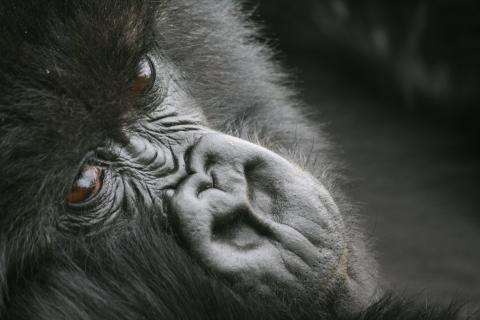
The Mountain Gorilla (Gorilla beringei beringei) is perhaps the World’s most endangered ape, with approximately 700 animals, and they are only found in small portions of protected afro-montane forests in north-west Rwanda, south-west Uganda and the eastern Democratic Republic of Congo. Half the population lives in the area of the Virunga volcanoes, and the other half lives in the Bwindi Impenetrable Forest, although located close to one another, expanding agriculture and the clearing of forest habitat means these two populations are now isolated from one another.
Gorilla trekking is tightly controlled and regulated for the safety of the visitor and importantly for the safety of the Mountain Gorillas. A maximum of 8 visitors may visit a group of habituated Gorillas on any given day, this minimizes behavioral disturbance and the risk of their exposure to human-borne diseases.
Gorilla Groups:
There are currently SEVEN groups habituated to visitors in Rwanda.
Amahoro group - 15 individuals located on the Visoke volcano.
Hirwa group - 12 individuals located on the Sabinyo volcano.
Umubano group - 7 individuals located on the Visoke volcano.
Sabinyo group - 10 individuals located between the Sabinyo and Visoke volcanoes.
Susa group - 35 individuals located high on the Karisimbi volcano (long and strenuous hike).
Group 13 - 21 individuals located on the Sabinyo volcano.
Kwitonda group - 10 individuals located on the Sabinyo volcano, sometimes in Democratic Republic of Congo and thus off-limits.
Only the Park Authorities will assign which gorilla group you will visit.
You will trek from the Park Headquarters to where the guides observed the Gorillas the day before, from there you will track the Gorillas. The trails may be very muddy, slippery and portions will be quite steep and strenuous.
Gorilla Viewing Rules:
Keep a minimum of 21 feet (7 metres) from the Gorillas - this is to protect them from catching diseases.
Do NOT remove anything from the park e.g., flowers, fruit, porcupine quills, etc.
Keep your voices down at all times.
No Flash photography is allowed.
Do NOT eat or drink when close to the gorillas - this is a disease risk.
Do NOT touch the Gorillas - they are wild animals.
The maximum time you can spend with the gorillas is ONE hour, however if the gorillas become agitated or nervous the guide will finish the visit early.
If you are feeling ill, or are carrying a contagious disease, please volunteer to stay behind. An alternative visit will be arranged for you, or you will be refunded your viewing permit money.
Do NOT spit in the park and go to the bathroom only as instructed by your guide.
Do not leave anything in the park, if you pack it in, pack it out!
Obey the local guide instructions at all times, for the safety of the Gorillas and visitors.
Practical Information
Currency: Rates effective April 2006. The currency of Rwanda is the Rwanda Franc (RWF) and 1 USD = 540.5 RWF.
Major credit cards are generally accepted at hotels, some restaurants and larger stores. U.S. dollars are of course widely accepted in Rwanda, so we suggest you carry U.S. currency in small denominations for smaller purchases such as refreshments or other miscellaneous expenses.
Health: All information we obtain regarding health precautions is received from the Centers for Disease Control in Atlanta at 404.332.4559 or www.cdc.gov.
Please note that Terra Incognita Ecotours, Inc., as a travel company, is in no way authorized to prescribe any inoculations or medications. We recommend that you consult your personal physician or a travel clinic specialist for medical advice, showing him or her the brochure that indicates the places you will be visiting. Your physician is most familiar with your personal medical history and is best qualified to determine your particular needs. It is always advisable to have physical and dental check-ups before you leave.
At the present time, several immunizations are recommended/required for this ecotour, (e..g., Yellow Fever) and the CDC recommends that the normal "childhood" vaccines should also be up to date: Measles, Mumps, Rubella (MMR Vaccine), Diphtheria, Tetanus, Perturssia (DTP Vaccine) and Polio vaccine.
Swimming: There is an opportunity to swim during the ecotour, at the Lodge in Akagera, but there are no other swimming opportunities.
Time Difference: Rwanda is seven hours ahead of Eastern Standard
Time, but during Daylight Savings Time (March
- November) the time difference can be reduced by one hour.
Weather: Rwanda is located close to the Equator, daytime temperatures can reach 80 to 90 degrees Fahrenheit, but, due to the high altitudes (5,000 to 9,000 feet) you will be visiting, the mornings and evenings are cooler and nights can feel a little cold. Please remember that the sun’s rays are more vertical than you may be used to, so you can sunburn more easily, and the additional altitude makes the sun’s rays even stronger. Be very careful of the midday sun.
There are two seasons in Rwanda; the long dry season (June to September) and the wet season, which can be divided into the big rains (mid-February to June) and the small rains (mid-September to mid-December). However, due to the high altitude, rain is possible at any time of year, and the weather can change quite quickly. Typically in the rainy season it rains in the afternoons and the mornings are bright and sunny. Although one can almost depend on clear, sunny weather, there are occasional unseasonable storms, and brief but intense rain showers occur regularly in the tropical regions during any season.
What to pack for your ecotour
Your travel wardrobe should be informal, comfortable and carefree. Clothing which can be layered is the most suitable, for example, a T-shirt, sweater or sweatshirt, and windbreaker or jacket. The emphasis is on casual attire.
Recommended items:
Hiking boots (waterproof or water-resistant) as they provide good traction for walks on sometimes-slippery
terrain.
Comfortable "closed" walking shoes with rubber soles and good support. Tennis
shoes would be a good choice.
T-shirts, polo shirts, and/or other comfortable short-sleeved shirts.
Gloves - for protection against nettles and stinging plants on the gorilla
treks.
Shorts.
A bathing suit - if you plan to swim while in Kigali.
Long-sleeved shirts for protection from the sun and stinging plants.
Cotton or other lightweight long pants.
Windbreaker or light sweater.
Rain jacket and waterproof trousers.
Sunhat.
Sunglasses.
Waterproof sunblock (30 SPF minimum).
Waterproof insect repellent.
A small backpack or rucksack.
Waterproof bags to protect your camera and binoculars.
Binoculars.
Flashlight.
Camera, lenses and plenty of film.
Extra camera batteries and inverters/adaptors if you need to recharge.
Prescription medicines. If certain medicines are part of your daily health
regimen and are vital to your health, make sure you bring an adequate supply
for the duration of your ecotour.
Travel Alarm Clock.
Binocular guidelines
Good binoculars and their proper use can add immeasurably to enjoying wildlife. Each traveler with Terra Incognita Ecotours should decide well before a trip begins whether the binoculars you own are adequate and, if not, what kind of binoculars should be acquired.
Recommendation Binoculars are rated with two numbers, e.g. 7 x 35. The first number is the magnification and the second is the diameter of the objective (the larger ones) lenses in millimeters. The first tells how much an object is enlarged and the second number is a measure of how much light-gathering power a lens has. As the second number increases so usually does the weight of a pair of binoculars. If one divides the first number into the second, the closer the result is to 5 the better the balance between weight, magnification and resolution.
Binoculars that are rated at 7x35, 8x40 or 10x40, are among the best for wildlife viewing. Binoculars with a center focus are much preferable over ones in which you have to focus each eyepiece separately. For some, image stabilized binoculars are an asset. Now it is a matter to decide on price and style.
The following is a checklist of things to do to make sure that you have the best binoculars and know how to use them.
Binocular cups Binoculars usually are constructed so that you can raise and lower the cups that surround the eyepieces. If you are going to wear eyeglasses when using binoculars, roll or push the cups down. This will bring the lenses of the eyepiece the proper distance from your eye. If you do not use glasses then leave the cups unrolled or the eyepiece frames elevated.
Distance between eyepieces All binoculars can be adjusted so that the distance between the eyepieces varies. You should move the eyepieces apart as far as they go, look through the eyepieces and gradually move the eyepieces together until you see a single image.
Adjusting each lens to your eyes Binoculars usually have two focus adjustments, one that is a center focus that moves both lenses at the same time and one, called the diopter, that adjusts only one lens, usually the right one. To adjust the lenses to your eyes look through the binoculars with your right eye closed. With the center focus wheel, focus on an object 20-40 feet away. Then, with the left eye closed, focus the eyepiece on the right eye while looking at the same object. Now using the center focus make sure you see a sharp image. Most diopters have a numerical scale so that after you have made the adjustment it can be easily reset if it is accidentally altered.
Practice When viewing wildlife it is helpful if when you raise your binoculars that they are pointed at what you are looking at with your naked eyes. If you cannot do that consistently a little practice would be helpful. Try looking at a flying bird, without taking your eyes off it, raise your binoculars and look through them. If you see the bird immediately, good, if not, bring your binoculars down and put them back up again after re-spotting the bird. Do this enough so that you can immediately see in your binoculars what you were seeing without them.
Wearing binoculars If the weight of binoculars around your neck is bothersome, there are two things you might consider. One is to buy a neck strap, made of a spongy material at least an inch or more wide. The second is to buy a harness that fits over the shoulders and distributes the weight more evenly.
Photography Notes
For many of us, photography is a natural and fun part of travel. No matter what your level of interest, or what kind of equipment you use, the following may help you prepare.
Flash photography is NOT allowed when viewing the Mountain Gorillas, please be sure you can turn-off or disable the flash feature, or you will not be able to take pictures.
Equipment: Regardless of what camera you use - film or digital
- be sure to check that it is working properly before you leave home. If you
purchase a new camera, or have an old one that has not been used for a long
time, try shooting some pictures and examine the results. Also, be sure read
your camera manual and bring it with you to help address any unexpected problems
you might encounter.
Batteries: Modern cameras will not operate without a functioning battery. For this reason, please bring extra camera batteries with you, even if the one in your camera is new. For digital cameras, and many film cameras as well, rechargeable batteries are a great option. Digital cameras can use up batteries fairly quickly, depending on the camera make and model and how often you review images in-camera. Bring at least one extra rechargeable battery - or battery set. Look for chargers with a fast recharge time. Rwanda operates on 220V.
Film: How much film should you bring? Consider bringing at
least twice as much film as you expect to need, as stores are few and far between.
And be forewarned - enthusiastic photographers sometimes shoot up to 5 rolls
per day! Film speed (ASA or ISO) is also an important consideration - the higher
the ISO the faster the film, meaning the more sensitive it is to light. For
most situations, 200 ISO film is a good all-around choice. You may also want
to bring along a supply of 400 ISO for overcast days and low-light situations.
Professional photographers generally use 100 ISO because of its fine grain
(good for making big enlargements and publishing), but the slow speed requires
extra care and use of a tripod.
Digital Memory Cards: Memory cards are the digital equivalent of film and, like film, they come in different types (e.g., compact flash, smart media, memory stick) and sizes (e.g., 128MB, 256MB, 512MB). Be sure you know what kind of memory card your camera requires and bring as many memory cards as needed to hold all your images from your expedition. If you are new to digital, consult your camera manual to learn the different image resolution and JPEG compression settings on your camera. This will determine how many photos will fit on your memory cards and what quality of image is required for your end use (e.g., the higher the resolution the larger the print you can make). You might consider bringing a digital storage device for downloading images from your memory cards (see below).
Digital Storage Devices: Many digital photographers travel with a laptop computer or a specific type of portable digital storage device designed for downloading images from digital cameras. A laptop has the advantage of letting you view, edit, store, and share your images while you travel and many even have a built-in CD burner for backing up your image files. Options for smaller devices that do not require a laptop include portable digital storage hard drives, some available with viewing screens, and portable CD burners that work directly from the memory card. Whatever hardware you choose be sure to learn the workflow for downloading and storing your images before leaving home.
Digital Camera Cables: One of the greatest advantages of shooting digital is the ability to review and share your daily images with others. It is important to remember to bring along the cables that will allow your camera to connect with a computer (USB), or storage device.
Tripods: Many photographers use a tripod because they help keep the camera steady in low-light situations, however they are discouraged as they can alarm the gorillas.