

Maximum group size is EIGHT individuals
2012 Departure dates:
Friday 9th March (FULL);
Tuesday 13th March (FULL);
Saturday 17th March (FULL);
Wednesday 21st March (FULL) and
Sunday 25th March (ONE space)
This is an Ecotour that will make a difference to you, and to the areas we visit.
We will donate to the important work of the World Wildlife Fund - India.
We will employ local people.
We will use locally owned and operated lodges and outfitters.
We will use local goods and services.
Reserve your space today - Call 1-877-GO EXPLORE or visit www.ecotours.com

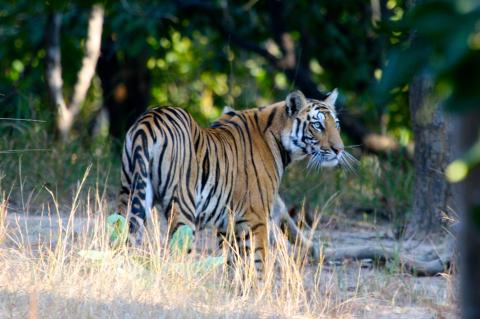
We will visit two famed tiger habitats.
Corbett National Park – This park has been the inspiration and setting for numerous books - F.W. Champions celebrated photography of Tigerland. The first ever books on Indian wildlife Photography (With a Camera in Tiger-land and The Jungle in Sunlight and Shadow) and Jim Corbett’s tales of man eating Tigers all were written and photographed in theses very same jungles.
Corbett National Park is the only park in India where you can actually stay inside the park and also walk inside the Park in certain areas. Currently this park has the highest density of tigers per sq km, some 162 Tigers in total. Out of 1200 species of birds found in the Indian sub continent, close to 600 are found here as elevation in the park ranges from 400 meters (1312 ft) at its lowest to 1210 meters ( 3970 ft) at its highest. A bird-watcher bonanza!
Bandhavgarh National Park – Here are the jungles of central India written about in Rudyard Kipling’s “Jungle Book”. There is plenty to see in this small park (168 Sq miles) set around a historic site, with carvings, temples and fort. This park is consistently known as the Park to have the highest concentration of tigers in the designated “tourist zone”, who are very vehicle friendly. Indeed on our investigative trip in February 2011 we saw seven tigers in three days here!

Daily Itinerary:
Day 1: Arrive Delhi
On arrival at the Indira Gandhi International airport, you will proceed for Immigration clearance after disembarking. After collecting your luggage from the baggage carousel, walk to the Arrivals Lounge where you will be greeted and transferred to the hotel.
Delhi, Capital City of independent India rewards the determined sightseer with more than a thousand monuments and two old capital building complexes - including the present seat of Government, designed by the British architect Sir Edwin Lutyens. Cosmopolitan hotels, shopping, and fine restaurants abound. Delhi also offers a glimpse into the real India: the labyrinthine street bazaars of Old Delhi, and the temples and monuments of India’s chequered colonial past. In the deepest sense, from Old Delhi’s Red fort and Jama Masjid mosque to New Delhi’s chic art galleries and nightclubs, Delhi is a profoundly Indian city. Turbaned shepherds still lead goats and sheep through ravines in Delhi’s remaining open fields and near the airport. On Delhi’s golf courses Mughal monuments share fairways with peacocks. Rajasthani women in bright colored saris and men in dhoti (skirt like wrap) work with outdated tools in construction sites while executives work out on computerized equipment in health clubs. By day, you will see temples packed with the devout, and by night, hotel discos are packed with the affluent. Delhi is a city on the move and the gateway to India. (Check in is no earlier than 2 pm).
Overnight at Hotel Claridges (D)
Day 2: Delhi
Today we offer a relaxed, full day guided tour of Delhi. Old Delhi came into existence after Mughal emperor Shah Jahan moved the capital from Agra to Delhi in 1638, and took around ten years to be completed. This old city is a dense network of narrow alleys and tightly packed markets and houses. We begin our tour with a visit to the Red Fort (from the outside only). Built between 1639 and 1648 on the banks of the River Yamuna, the fort built of red sandstone from which it derives its name, is bulging with turrets and bastions. At the site of the Red Fort we exchange our motorized transport for an eco-friendly mode of transportation synonymous with Old Delhi – the cycle rickshaw. Using this unique vehicle, we traverse the narrow lanes of Chandni Chowk, teeming with people and cattle. Here we pay a visit to the famous Kinari Bazaar which is the unofficial centre of wedding accessories as well as Dariba Kalan street which is inhabited mainly by jewelers, dealing in silver and costume jewelry nowadays. Literally translated "street of the incomparable pearl", it derives its name from the Persian 'Dur-e be-baha', meaning pearl without compare. We also visit Jama Masjid which is India’s largest mosque (built between 1644-56 by 5000 artisans and workers). At any given time, 25000 devotees can assemble in the mosque for prayers.
After lunch we resume our tour of Delhi by visiting New Delhi, first with a visit to the central part of Delhi fondly known as Lutyen’s Delhi. Built by Sir Edwin Lutyens and designed by Hebert Baker, it consists of wide tree-lined avenues and grand colonial buildings. Here we visit the India Gate – memorial to the Indian soldiers who died in the 1st World War where an eternal flame pays tribute to the brave soldiers. From there, drive past the two secretariat buildings (known in government parlance as North and South blocks) on either side of the Rajpath (King's way) leading to the presidential palace. The two classical buildings, topped by Baroque tomb, borrows from the mughal and rajput schools of architecture, using decorated stone screens known locally as “Jalis” and screens slanting outside a building to protect it from the vagaries of weather known as "Chajjas". The drive leads up to the awe inspiring Rashtrapati Bhawan, the former residence of the Viceroys of India, and now the official residence of the Indian president. It is the finest example of Sir Lutyen’s expansive vision and stands atop the Raisina Hill. Built in Indo-Saracenic style, it is a masterpiece of symmetry, discipline, silhouette and harmony. Drive past the Indian parliament building which is circular in design and is known as the "Sansad Bhawan". The tomb of Emperor Humayun is an early example of the Mughal style of tomb. A precursor to Taj Mahal, it was built by the Empress Hamida Bano over a period of 8 years.
Welcome cocktails and dinner at the hotel this evening in the fine Indian Restaurant.
Overnight at Hotel Claridges (B,L,D)

Day 3: Delhi to Corbett National Park by private charter plane
After breakfast transfer to Delhi International airport to board our private charter flight to Pantnagar airport (1 hour duration). We are met on arrival and transfer to Camp Forktail Creek (80 kms, 2-3 hours).
Arrive at Camp by early lunch. After a quick clean-up and a sumptuous lunch, we enjoy an escorted nature and bird walk into the Sal forests surrounding camp. It is an excellent opportunity to walk in the cool of the forest, to be so close to nature and to appreciate the varied plants, insects, birds, mammals and reptiles that inhabit this part of the country. We will learn how to identify the footprints/tracks of various animal species and track them.
Walk back to camp by sundown, where we will gather around the campfire for cocktails, followed by a delicious dinner. Our Naturalist hosts will amuse and amaze us with their stories of exciting experiences in Corbett.
Overnight at Camp Forktail Creek (B,L,D)
Day 4: Corbett National Park – all day
Depart early this morning in two dedicated open top jeeps for a full day game drive into the Bijrani zone. We carry a packed breakfast to enjoy once in the Park, and we will travel deep into the Park where we will enjoy a private hot lunch to be served by our team from Camp at Malani Forest Rest House within this zone. After a quick wash on the return to camp late this afternoon, join our naturalists by the campfire for drinks and snacks and resume the discussions leftover from the previous night. For those of us weary from the long day, dinner will be ready under the Thatch after which you could settle into your comfortable beds in the Cottages.
Overnight at Camp Forktail Creek (B,L,D)
Day 5: Corbett National Park – two-day experience
After an early breakfast at the lodge, depart for the Forest Rest House at Dhikala. Enter through the Dhangari gate - a mere 6 kms from Camp. Our route today will be via Gharial pool, and then Champion pool on Champion road and High Bank – each one of them great observation points on the Ramganga River. Here we hope to spot Gharial and Otters and much more!
We plan to arrive at the Dhikala Forest Rest House by lunch. After a hot lunch at the rest house we will board Elephants for an elephant-back safari in search of wildlife in the Dhikala “chaur” – grasslands, to observe the varied bird and mammal species found in the area.
Back for an evening dinner and overnight stay at the Forest Rest House in Dhikala, located deep inside the Park on the shores of a reservoir, the wildlife viewing inside the Park here can be quite spectacular.
Overnight at Dhikala Forest Resthouse (B,L,D)

Day 6: Corbett National Park
We have a full day to explore the area around Dhikala with a morning game drive and another game drive after lunch. Enjoy a hot lunch again at Dhikala Forest Rest House before we begin the journey out of the Park and return to Camp. Along the way we will still be searching for wildlife, listening for the alarm calls from Spotted deer or Muntjac in case a leopard or tiger is on the prowl!
Overnight at Camp Forktail Creek (B,L,D)
Day 7: Corbett National Park to Bandhavgarh by private charter flight
We enjoy a cooked breakfast at Camp at around 06:30 am. After breakfast we bid farewell to our Naturalists and the rest of the camp team and depart for Pantnagar airport for the private flight to Bandhavgarh (we arrive at Umaria airstrip – 30 kms and only 30 minutes away from our lodgings at Bandhavgarh).
We are met on arrival at Umaria airstrip and transfer to Bandhavgarh National Park and lunch at Kings Lodge. This afternoon we enjoy an afternoon game drive with naturalist in open top Jeeps, our objective to spot tigers in this prime locale for tiger viewing. (Time Permitting)
Overnight at Kings Lodge (B,L,D)

Day 8: Bandhavgarh National Park
Early this morning we assemble for tea / coffee and then set off for a game drive. Mornings can be cold inside the forest but will warm up as the sun rises. Blankets will be provided by the lodge to keep you warm.
Today (or tomorrow) we will get special permission and visit the fort inside the park and explore it on foot and have breakfast close to vulture nesting sites. We return to Kings Lodge for lunch and this afternoon enjoy another game drive and return around sunset.
Overnight at Kings Lodge (B,L,D)
Day 9: Bandhavgarh National Park
Early morning we assemble for tea / coffee at and then set off for a game drive, return to the Lodge for a cooked breakfast around 10:30am to 11:00am. Siesta around lunchtime and then another afternoon game drive and return around sunset.
Overnight at Kings Lodge (B,L,D)
Day 10: Bandhavgarh National Park
Early morning we assemble for tea / coffee at and then set off for a game drive, return to the Lodge for a cooked breakfast around 10:30am to 11:00am. Siesta around lunchtime and then another afternoon game drive and return around sunset.
Overnight at Kings Lodge (B,L,D)

Day 11: Bandhavgarh National Park to Delhi by private charter flight and flights home
Early morning we assemble for tea / coffee at and then set off for a game ride. Return to lodge for a late breakfast. After a quick clean-up and packing we will transfer to Umaria airstrip to board our private flight to Delhi (2 hours duration). We are met on arrival and transfer to Oberoi Trident Gurgaon where rooms are reserved for day use.
Late this evening we have our Farewell Dinner and then offer a transfer to the International airport to board your International flight home.
NOTE: (Check In is three hours prior to flight departure for economy class and two hours for business class)
Day room at Oberoi Trident Gurgaon (B,D)
Cost per person is $8,249
Single supplement is $1,500 per person
COST INCLUDES:
Not included:

Sightings of wild Tigers cannot be guaranteed.
About our lodgings
Claridges Hotel, Delhi
Set in the leafy boulevards of New Delhi, Claridges Hotel has been a landmark in Lutyens Delhi since the 1950’s. The 3 floor low rise building, dating from the 1930's, has a mildly Art Deco feel to it and a calm understated elegance, in keeping with the spacious bungalows that line the streets of the city. The lobby, with its fine double-crescent staircase, sets the tone for the rest of the hotel. There is a business centre, a swimming pool and a health club. The hotel also has a number of restaurants and a congenial bar.
Oberoi Trident Gurgaon
Trident Gurgaon is five star hotel for business as well as leisure travelers. It is conveniently located and only about 15 minutes drive from the International airport on the Delhi to Jaipur highway. Set in seven acres of beautifully landscaped gardens, the hotel has an imposing yet serene presence, a resort-like ambience. It is characterized by domes, long walkways, inner courtyards, reflection pools and fountains. The hotel has 136 rooms, which include a Presidential suite and six Executive suites, overlooking the garden, courtyards and pools. http://www.tridenthotels.com/gurgaon/index.asp
Camp Forktail Creek
Camp Forktail Creek is situated in the midst of a dense Sal forest and is rich with birdlife. It offers one a great "jungle" experience in the land Jim Corbett once roamed. It has 5 traditional mud cottages and 4 spacious safari tents on raised wooden floors, well spaced for privacy. Each tent has a deck and a fully functional toilet. The furnishings in each tent/hut include a chest of drawers with a dressing mirror, twin beds with soft duvets, side tables, deck chairs and a luggage table. Being an eco-friendly lodge, it is exclusively powered by solar energy.
Kings Lodge
Kings Lodge, Bandhavgarh is spread on 10 acres in the Rancha village surrounded by Sal forested hills. The Lodge is built using eco-friendly materials and has an eco-sensitive waste disposal systems. It has 4 cottage rooms and 8 stilt rooms with en-suite modern bathrooms. All rooms have air conditioners, Mini-bar, large verandah with great views of the forest, writing table and chair. All bathrooms are with 24 hour Hot and Cold water, bath tubs and all modern facilities. Meals are served in the dining room. The Lodge has a well stocked library, a dip pool and a watch tower. It is managed by a team of experienced naturalists with a focus on birding and an overall wildlife experience.

3-day / 2-night extension
2012 Departure dates:
18th March; 22nd March; 26th March; and 30th March
Overnight tour of Agra, former capital of the Mughal dynasty and home to one of the Seven Wonders of the World – the Taj Mahal - a dream in white marble. The extension includes one night in Oberoi Trident Gurgaon and one night in Oberoi Amarvilas. Return to Delhi to board onwards flight.
Day 11: Bandhavgarh to Delhi
Early morning we assemble for tea / coffee and then set off for our last game ride, and last chance to see tigers. Return to lodge for breakfast.
Clean up and pack then later transfer to Umaria airstrip to board private flight to Delhi (2 hours duration).
We are met on arrival and transfer to Oberoi Trident Gurgaon for the night, our fellow travellers will have day rooms here before their late evening flights home. If time permits we can enjoy a Farewell Dinner at the hotel with those departing and then we settle in for the night, to begin Agra extension programme the next day.
Overnight at Oberoi Trident Gurgaon (B,L,D)
Day 12: Agra and Taj Mahal
After a leisurely breakfast, we drive to Agra and check in to hotel. ( Check In begins at 2 PM ). The drive is on a good highway and takes about 4 hours. This afternoon we enjoy a guided tour of the Taj Mahal
“A teardrop on the cheek of time” is how the famous poet and Noble Laureate Rabindranath Tagore described the Taj Mahal. Built from white marble, it is the mausoleum of Empress Mumtaz Mahal, who died after giving birth to her 14th child (Princess Gauhar Begum). Built over a period of 22 years and involving thousands of artisans from across the world, this magnificent building is considered to be the greatest monument to eternal love, a homage to her beauty and life.
Overnight at Oberoi Amarvilas (B,L,D)

Day 13: Agra Fort to Delhi and flights home
After late breakfast we take a guided tour of Agra Fort. The Agra Fort, built by Emperor Akbar is considered one of the most important forts in India and a succession of Mughal emperors made this walled palatial city their home. It is semi circular in design and has four gates. The buildings inside the fort have a mix of Hindu and Islamic architectures. In fact some of the decorations feature images of living creatures such as birds, which are forbidden under the Islamic religion.
Today late afternoon drive to Delhi international airport for flight back home. (B,L)
Cost is $1,400 per person
$250 single supplement
COST INCLUDES:
Not included:
(Important note: The Taj Mahal is closed on Fridays so if your tour overlaps with a Friday here, we simply reverse order of your tours and visit the Red Fort today and the Taj Mahal on Saturday)
About our lodgings
Oberoi Trident Gurgaon
Trident Gurgaon is five star hotel for business as well as leisure travelers. It conveniently located and is about 15 minutes drive from the International airport on the Delhi to Jaipur highway. 25 minutes drive from downtown New Delhi. Set in seven acres of beautifully landscaped gardens, the hotel has an imposing yet serene presence, a resort-like ambience. It is characterized by domes, long walkways, inner courtyards, reflection pools and fountains. The hotel has 136 rooms, which include a Presidential suite and six Executive suites, overlooking the garden, courtyards and pools.
Oberoi Amarvilas
Located only 600 meters from the Taj Mahal stands Amarvilas, the Oberoi Groups luxury resort. Here discerning travelers can now appreciate the fabulous Taj Mahal while enjoying world-class luxury. The hotel has been designed to give guests uninterrupted views of the Taj Mahal from all 106 guest rooms and suites. The lobby, bar and tea lounge also offer spectacular views of the world-famous monument. Elaborate gardens, terraced lawns and fountains, reflecting pools and pavilions complement the classical architecture of the hotel.
The rooms at Amarvilas uphold the famed Oberoi tradition of luxury and comfort. The distinctive ambience combines old-world charm with state-of the-art conveniences. Each room has an entrance foyer, leading to a walk-in closet and the living area. Burma teak flooring and hand knotted rugs create a warm and welcoming atmosphere. The elegantly appointed interiors include an Indian style bed covered with hand woven fabrics, a richly inlaid desk, a luxurious lounge chair with an ottoman, and a marble inlaid coffee table. The bathrooms are luxuriously equipped in white marble and turquoise glass panels, with a separate shower cubicle and a large vanity counter holding deluxe toiletries. All rooms also have the most modern conveniences such as voice mail, a data port for computers, satellite television, digital videodisc players, and in-room electronic safes.
International Air Travel - International air is not included in the price of your trip, but we would be happy to have you work with AirTreks, our preferred provider of international air arrangements. We recommend our customers work directly with AirTreks as they coordinate your international flights directly with Ecotours and enable you to arrive at your destination at the times specified for your tour. Please contact AirTreks at ecotours@airtreks.com for more information on international air travel, a no obligation cost estimate of your international flights and complete international air itinerary planning.
Make sure to mention Terra Incognita Ecotours when you contact AirTreks to receive preferred pricing, and recommended travel itineraries specifically developed for your tour.
Travel Information
Thanks for choosing India with Terra Incognita Ecotours, Inc. It is our pleasure to help you plan for your upcoming ecotour. To ensure that your travel arrangements are made to your satisfaction, please take a few minutes to read through this information.
What you need to have with you on your trip:
Passport: If you are a U.S., U.K., Australian or Canadian citizen, you will need a passport, valid for six months from the date of completion of your trip.
It is always a good idea to make a photocopy of your airline tickets and of the pages of your passport that have the number, your photograph and other pertinent information. Keep the copies separate from the originals.
Visas: Please consult the India consulate or embassy nearest you for visa requirements to enter India. If a visa is required, you are responsible for obtaining it.
Documents for children under the age of 18, not traveling with both parents: The U.S. government is increasingly requiring that minors under 18 years of age traveling alone, with grandparents, or with one parent/legal guardian only, carry a notarized document signed by both parents or by the parent/legal guardian not traveling with the child. We suggest you obtain such a document (noting the age of the child, relationship to traveling adult(s), dates of travel, and destination) to avoid potential problems. For example, in the case of divorce, the parent with legal custody must sign the permit, and the accompanying adult must carry proof of this fact. In addition, if the child’s surname differs from that of either parent, you may want to carry the child’s birth certificate.
Emergency Contact number while on your ecotour:
Call COLLECT (813) 476-2810
Practical Information
India is the seventh-largest country by geographical area, the second-most populous country with over 1.2 billion people, and the most populous democracy in the world. Bounded by the Indian Ocean on the south, the Arabian Sea on the southwest, and the Bay of Bengal on the southeast, it shares land borders with Pakistan to the west; Bhutan, the People's Republic of China and Nepal to the northeast; and Bangladesh and Burma to the east. In the Indian Ocean, India is in the vicinity of Sri Lanka and the Maldives; in addition, India's Andaman and Nicobar Islands share a maritime border with Thailand and Indonesia.
Currency: The currency of India, is the Rupee (INR). The exchange rate as of March 2010 was 1 US$ = 44 INR. Major credit cards are generally accepted at hotels and larger stores. U.S. dollars are not widely accepted in India, so we suggest you change currency on arrival for smaller purchases such as taxis, refreshments or miscellaneous expenses.
Health: All information we obtain regarding health precautions is received from the Centers for Disease Control in Atlanta at 404.332.4559 or www.cdc.gov.
Please note that Terra Incognita Ecotours, Inc., as a travel company, is in no way authorized to prescribe any inoculations or medications. We recommend that you consult your personal physician for medical advice, showing him or her the brochure that indicates the places you will be visiting. Your physician is most familiar with your personal medical history and is best qualified to determine your particular needs. It is always advisable to have physical and dental check-ups before you leave.
At the present time, no specific immunizations are required for this ecotour, although the CDC recommends the following:
Please also note
Swimming There may be several opportunities to swim during the ecotour. You should bring a swimsuit if you may swim. Since you will have time to swim, for added protection from the sun you may wish to wear a T-shirt while swimming.
Time Difference: India is 5 and 1/2 hours ahead of Greenwich Mean Time.
Weather: India's climate is strongly influenced by the Himalayas and the Thar Desert, both of which drive the monsoons. The Himalayas prevent cold Central Asian katabatic winds from blowing in, keeping the bulk of the Indian subcontinent warmer than most locations at similar latitudes. The Thar Desert plays a crucial role in attracting the moisture-laden southwest summer monsoon winds that, between June and October, provide the majority of India's rainfall. During our visits in March, the mornings can be quite cold, the evenings will be cool, and the days will warm quite quickly, getting hotter quickly in late March.
Please remember that the sun’s rays are more vertical than you may be used to, so you can sunburn more easily. Be careful of the midday sun.