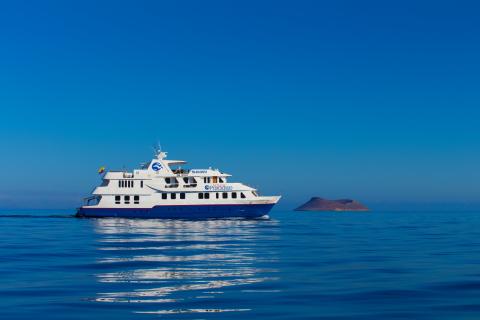


Aboard the MV Floreana
Celebrate Darwin’s bicentenary by walking in his footsteps on a trip to the Galapagos Islands! These islands are home to some of the most interesting and accessible wildlife anywhere. Swim and snorkel with the sea lions, come within mere inches of the blue-footed booby and a marine iguana, allow a Hood mockingbird to alight on your head. Your trip will include a visit to the Charles Darwin Research Station, world famous for its research and tortoise breeding programs, where we learn about the vital work being done to study and preserve Galapagos wildlife. Visit nests of the magnificent frigatebirds, search for giant tortoises in the wild, experience the diversity of the legendary finches. You will gain an appreciation for how remarkable life on Earth can be!
Departure Dates: December 22 to January 1, 2010
Only TWO spaces left on this departure!
Cost is $4,999 per person
Detailed Itinerary
This is an Ecotour that will make a difference to you, and to the areas we visit.
We will make a contribution to the Darwin Reserach Institute.
We will employ local people.
We will use locally owned and operated lodges and outfitters.
We will use local goods and services.
Day 1: Home to Quito, Ecuador
Depart this morning for the flight to Quito Ecuador, where you will be met and transferred to the charming boutique hotel, the Hotel Patio Andaluz, in the colonial city of Quito, located in the highlands of the Ecuadorian Andes. Tonight get to know your fellow explorers as we enjoy our Welcome Dinner.
Overnight in Hotel Patio Andaluz, Quito (D)
Day 2: Quito
Today we have the whole day to explore the historic Colonial city of Quito - our hotel is practically adjacent to the main plaza in the old town, so we can easily stroll to many of the cathedrals, churches, museums and attraction of Quito including the incredible Iglesia y Convento de San Francisco and the stunning gold covered ceilings of the former Jesuit church of La Compania. We will enjoy lunch in the historic center and in the afternoon visit the remarkable art gallery of Guayasamin, easily the most famous of all Ecuadorian artists. This evening we again enjoy dinner at our charming hotel.
Overnight in Hotel Patio Andaluz, Quito (B,L,D)

Day 3: Quito to Baltra, Galapagos and North Seymour Island
This morning we drive the short distance back to the International Airport for our flight to Baltra in the Galapagos Islands. We should arrive before lunch and immediately transfer to our home for the next week, the comfortable 16 passenger MV Floreana. Once aboard we will get underway, our first destination is North Seymour Island, where the flat topography is strewn with boulders due to its origins as an uplifted, not volcanic, island. You should expect to see large populations of Magnificent Frigatebirds due to the ideal nesting sites, Blue-footed boobies perform their courtship dance in the more open areas and Swallow-tailed gulls perch on the outer shore. Sea lions and Marine iguanas can also be seen hauled out on the beach.
Overnight on board MV Floreana (B,L,D)
Day 4: Isla Santa Cruz - Dragon Hill and Whale Bay
On entering the trail at Dragon Hill you pass a stunning lagoon which is often frequented by flamingos and assorted shore birds. The trail then ascends up a hill where land iguanas can be found, numerous finch species and some wonderful sea scapes. Later in the day we visit Whale Bay on the cost of Santa Cruz Island, this semicircular beach, is green in color, due to a high volume of olivine crystals. The beach extends 25 meters from the base of the hill, and is of some historical interest as it was the first trail to the highlands used to search for fresh water. There are a number of pieces of ceramics strewn about, although no verified information exists concerning the origins of the ceramic. Here we can often find a curious Galapagos Hawk.
Overnight on board MV Floreana (B,L,D)
Day 5: Isla Santa Cruz - Charles Darwin Research Center
Founded more than twenty years ago to assist the National Park Service in its efforts to save Galapagos wildlife, the Charles Darwin station plays an important part in monitoring and assessing the state of the islands. Today you will find buildings housing the different scientific areas of the station, a library and homes of scientists and tortoise keepers. The museum at the station has a facility for rearing tortoises - a project to increase the depleted populations of several species. Also the world famous Lonesome George can be found within the stations breeding program - the last of his kind on earth! Later we head up to the highlands and an amazing opportunity to see the magnificent Giant Galapagos tortoise in its natural habitat, having just seen them in the breeding program in the station, you can now see them bathing and eating in the wild (depending on the season). This area is vegetated with transition zone vegetation and is located in the humid zone of the highlands of Santa Cruz. The walk to the reserve is one of the best places to observe ground birds, tree and ground finches, the Vermillion flycatcher, Cattle egrets and occasionally Galapagos rails.
Overnight on board MV Floreana (B,L,D)

Day 6: Isla Floreana - Post Office Bay and Punta Cormorant
As one of the oldest islands, Isla Floreana has the most interesting human history. It has stories of marooned whales, prisoners and colonists as well as bizarre disappearances and even murders! It is made up of numerous extinct volcanic cones and has well established extensive scrubby vegetation. In the morning we visit Post Office Bay, significant for its human history - in 1793 James Colnett the captain of a whaling vessel, established the wooden post barrel on Floreana, whaling ships, typically offshore for two years at a time, frequented the archipelago, so outbound ships would drop off letters after rounding the Cape and the ships returning home would mail them. Over the years, thousand of ships have stopped to send and receive mail at Post Office Bay. This will be your opportunity to partake in this amazing postal service. You will be given letters to take home and mail to their intended recipients, and also have the opportunity to drop off letters ourselves! In the afternoon we plan to visit Punta Cormorant which offers two highly contrasting beaches. The landing beach is of volcanic origin and is composed of olivine crystals, giving it a greenish tinge, and at the end of the short trail is a carbonate beach of extremely fine white sand, formed by the erosion of coral skeletons - a favorite nesting site for green sea turtles.
Overnight on board MV Floreana (B,L,D)
Day 7: Isla Espanola - Punta Suarez and Gardner Bay
This is the southernmost island, and has the densest and most diversified concentration of wildlife. Punta Suarez is home to Blue-footed boobies, Nazca boobies, Swallow-tailed gulls, American oystercatchers and the majestic Waved albatross breeding grounds. This makes this site one of the richest wildlife locations in the Galapagos Islands. The area is also famous for the marine iguanas with unique copper-red patches. In the afternoon we visit Gardner bay, an amazing white sand beach with stunning turquoise shallows beautiful to walk, swim or snorkel. You could just sit and admire the extrovert mockingbirds and the sea lions.
Overnight on board MV Floreana (B,L,D)

Day 8: Isla San Cristobal - Lobos island
Lobos island, as its name suggests is famous for its population of sea lions and fur sea lions. You will also encounter a nesting ground for the Great frigatebird and a small number of Blue-footed boobies. Later we visit an Interpretive Center where as is explained, in a simple manner, the natural phenomena that created the Galapagos Islands. They explain the series of natural processes, such as volcanic eruption and marine current locations that have lead to the amazing islands that you are now visiting.
Overnight on board MV Floreana (B,L,D)
Day 9: Isla Santa Fe - South Plazas
Lobos island, as its name suggests is famous for its population of sea lions and fur sea lions. You will also encounter a nesting ground for the Great frigatebird and a small number of Blue-footed boobies. Later we visit an Interpretive Center where as is explained, in a simple manner, the natural phenomena that created the Galapagos Islands. They explain the series of natural processes, such as volcanic eruption and marine current locations that have lead to the amazing islands that you are now visiting.
Overnight on board MV Floreana (B,L,D)
Day 10: Black Turtle Cove, Galapagos and Baltra Airport to Quito, Ecuador
Black Turtle Cove is on the northern coast of Santa Cruz Island and is one of the most beautiful marine sites; a small lagoon lined with dense red mangroves. It is a nursery grounds for many marine species such as sharks, spotted eagle rays and sting rays and it is a favored grazing area for the green sea turtle. It is also a wonderful site for watching, herons, finches and blue-footed boobies feeding. This site does not involve a land visit; it is all seen from the small pangas. Later we return to Baltra Island and finally your flight back to Quito.
Farewell Dinner and overnight in Hotel Patio Andaluz in Quito (B,L,D)
Day 11: Quito, Ecuador to home
After breakfast we transfer to the International Airport and our flights home
Cost per person is $4,999
Single supplement is $2,499
(B = Breakfast; L = Lunch; D = Dinner)
Cost Includes:
Not included:
Travel Information
Thanks for choosing the Galapagos Islands with Terra Incognita Ecotours, Inc. It is our pleasure to help you plan for your upcoming ecotour. To ensure that your travel arrangements are made to your satisfaction, please take a few minutes to read through this information.
What you need to have with you on your trip:
Passport: If you are a U.S. or Canadian citizen, you will need a passport, valid for six months from the date of completion of your trip.
It is always a good idea to make a photocopy of your airline tickets and of the pages of your passport that have the number, your photograph and other pertinent information. Keep the copies separate from the originals.
Visas: If you are not a U.S. or Canadian citizen, please consult the Ecuador consulate or embassy nearest you for visa requirements to enter Ecuador. If a visa is required, you are responsible for obtaining it.
Documents for children under the age of 18, not traveling with both parents: The U.S. government is increasingly requiring that minors under 18 years of age traveling alone, with grandparents, or with one parent/legal guardian only, carry a notarized document signed by both parents or by the parent/legal guardian not traveling with the child. We suggest you obtain such a document (noting the age of the child, relationship to traveling adult(s), dates of travel, and destination) to avoid potential problems. For example, in the case of divorce, the parent with legal custody must sign the permit, and the accompanying adult must carry proof of this fact. In addition, if the child's surname differs from that of either parent, you may want to carry the child's birth certificate.
Emergency Contact number while on your ecotour:
Call COLLECT (813) 289-1049

Practical Information
Currency: The currency of Ecuador is the U.S. dollar. Major credit cards are generally accepted at hotels, restaurants and larger stores. U.S. dollars are therefore accepted in Galapagos Islands, so we suggest you carry U.S. currency in small denominations for smaller purchases such as taxis, refreshments or other miscellaneous expenses.
Health: All information we obtain regarding health precautions is received from the Centers for Disease Control in Atlanta at 404.332.4559 or www.cdc.gov.
Please note that Terra Incognita Ecotours, Inc., as a travel company, is in no way authorized to prescribe any inoculations or medications. We recommend that you consult your personal physician for medical advice, showing him or her the brochure that indicates the places you will be visiting. Your physician is most familiar with your personal medical history and is best qualified to determine your particular needs. It is always advisable to have physical and dental check-ups before you leave.
At the present time, no immunizations are required for this ecotour, although the CDC recommends that the normal "childhood" vaccines should be up to date: Measles, Mumps, Rubella (MMR Vaccine), Diphtheria, Tetanus, Perturssia (DTP Vaccine) and Polio vaccine.
Swimming & Snorkeling: There are several opportunities to swim and snorkel in the Pacific Ocean during this ecotour. You should bring a couple of swimsuits, and we advise you to bring your own snorkeling gear (mask especially) to ensure a comfortable fit, especially if you require prescription eyewear as prescription lenses will not be available locally.

We advocate the buddy system for everyone, at all times, and children less than 14 years of age must be accompanied by an adult while snorkeling.
Since you will have ample time to swim, for added protection from the sun you may wish to wear a T-shirt while swimming.
Time Difference: Galapagos Islands is one hour behind Eastern Standard Time. During U.S. Daylight Savings Time (March through October), Galapagos Islands is two hours behind Eastern Time.
Weather: The Galapagos climate is heavily effected by cold water currents. Generally speaking, the days are warm and the nights are cool. Humidity is low. The climate is very similar to that of California. There are two primary seasons during the year. Each offers a good time for visiting the islands, but the character of each season is somewhat different. December through June is the warmer time of year, with highs in the 80s. Although the islands receive relatively more rainfall during this time, most of the lower elevations of the islands are quite arid and there is plenty of sunshine and blue skies. The sea is at its warmest, and is usually calmer at this time of year. The drier garua season lasts from June or July through November. The garua is a mist that forms in the highlands of the islands. Ironically, the garua season provides more moisture at the upper levels of the islands than the so-called wet season. There is plenty of sunshine during the day, but it is less intense, with cloudier skies. Air temperature is lower, with highs in the upper 70s. The climate at this time is affected by a strong Antarctic current, the Humboldt Current, coming from the south. The water temperature, therefore, is at its coolest during this time, about 68 degrees Fahrenheit.